First timers · 6 min read
Ayurveda retreat basics: the consultation, the routine, the food and the treatments
What to expect at an Ayurveda retreat in India, from the first consultation with the doctor to a typical day, the food, and what the common treatments actually feel like.
Written by RetreatAdvisors editors · Updated October 2026
Quick answers
- What happens at an Ayurveda retreat?
- An Ayurvedic doctor sees you on arrival, then plans your treatments, food and daily routine. Most days have one to three treatments, some yoga or a walk, simple meals and plenty of rest, with check-ins with the doctor through the stay.
- How long should I stay?
- A week is the usual minimum for a programme that does anything more than relax you; Panchakarma takes two weeks or more. Across the 76 we list, the typical minimum stay is 3 nights, and 19 ask for a week or more.
- Is the food vegetarian?
- Usually. Meals are simple, warm and planned around what the doctor advises for you, and alcohol is off the menu. Of the 76 Ayurveda retreats we list, 43 say their kitchens are vegetarian or sattvic and 2 offer non-vegetarian food; the rest don't say.
- Do I need a health problem to go?
- No. Many guests go to rest and reset, and Ayurveda has a long tradition of rejuvenation programmes (rasayana) for people who are well. Tell the doctor honestly why you've come.
On this page
The first consultation
Everything at a proper Ayurveda retreat starts with the doctor. The first consultation usually takes 30 to 60 minutes, on your arrival day or the next morning.
- Questions about you: your health history, sleep, digestion, energy, stress, periods, and every medicine and supplement you take.
- An examination: the doctor reads your pulse at the wrist (nadi pariksha), looks at your tongue and eyes, and often checks your blood pressure and weight.
- Your constitution: Ayurveda describes each person by the balance of three doshas, vata, pitta and kapha. Your prakriti (constitution) and your current state shape the plan.
- The plan: which treatments, in what order, the food you'll get, any herbal medicines, and the daily routine.
A typical day
Every centre has its own rhythm, but most days look something like this:
- 6:00 am
- Wake up. Gentle yoga, breathing practice or a walk.
- 7:30 am
- Herbal medicine or a warm decoction on an empty stomach, if prescribed.
- 8:30 am
- Breakfast, often porridge, idli or kanji (rice gruel).
- 9:30 am–12:30 pm
- Treatments: usually one or two sessions of 45 to 90 minutes, then a herbal bath.
- 1:00 pm
- Lunch, the main meal of the day.
- 2:00–4:00 pm
- Rest. Napping straight after oil treatments is often discouraged, so read or sit outside.
- 4:30 pm
- Another treatment, a doctor's check-in, a talk or a cooking demonstration.
- 6:00 pm
- A walk, meditation or a bhajan session.
- 7:30 pm
- A light, early dinner. Lights out by about 10 pm.
What the treatments are like
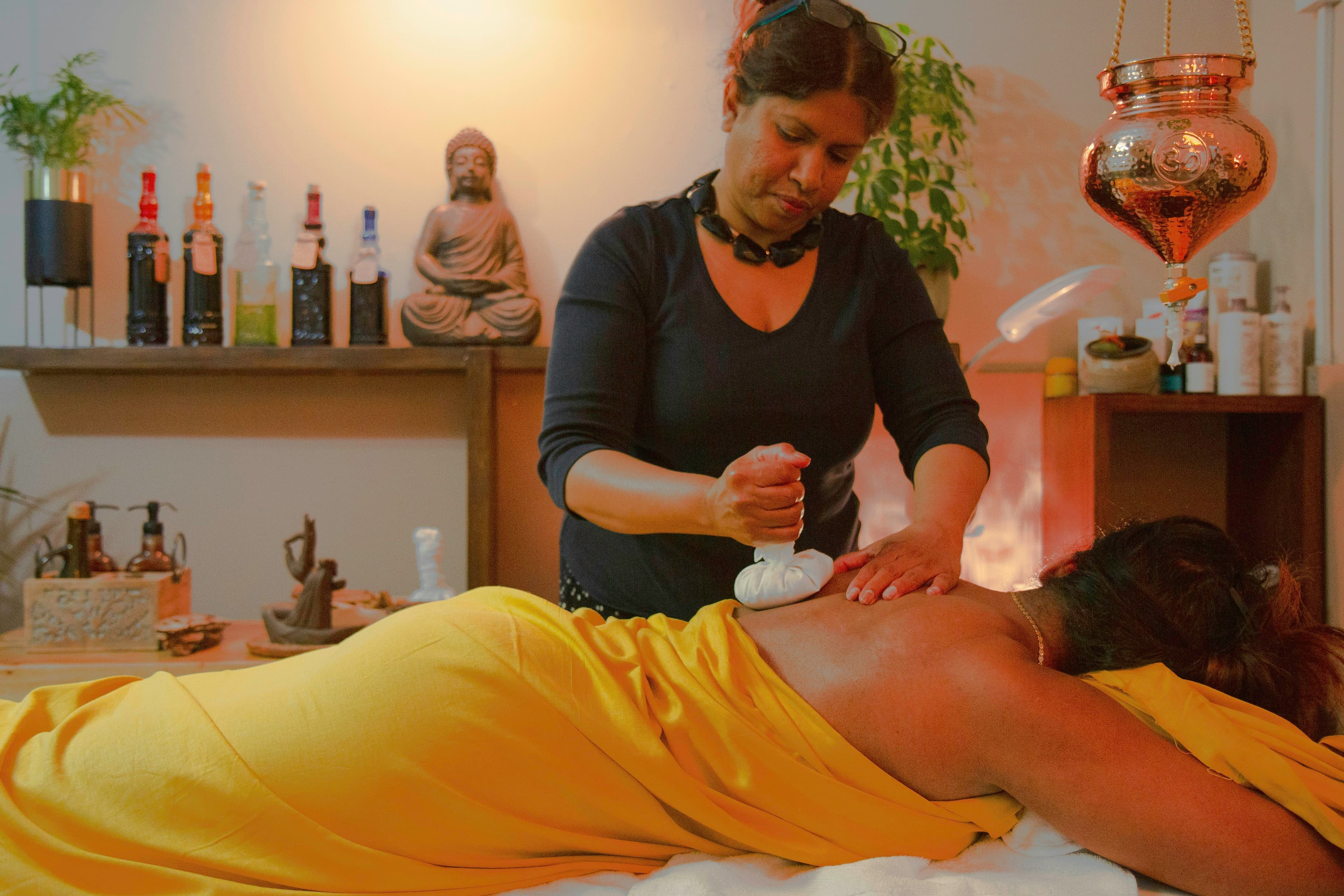
Ayurvedic treatments are long, warm and very oily. You'll lie on a wooden treatment table called a droni, wearing a disposable loincloth, with one or two therapists of your own gender. Afterwards you wash off the oil with a herbal powder in place of soap.
- Abhyanga
- A full-body massage with warm medicated oil, often by two therapists working in step. Firm, rhythmic and relaxing.
- Shirodhara
- A thin, steady stream of warm oil or buttermilk poured across your forehead for 30 to 45 minutes. Many people drift into something close to sleep.
- Kizhi
- Warm cloth bundles of herbs, leaves, rice or powder, dipped in oil and pressed and patted over the body. Feels like a hot compress with rhythm.
- Pizhichil
- Warm oil poured continuously over the body while you're massaged. Very relaxing, and very oily.
- Udvartanam
- A brisk massage with dry herbal powder, upwards against the hair. Invigorating rather than sleepy.
- Nasyam
- Medicated oil drops in the nose after a face massage and steam. Brief, and a little intense.
- Steam
- A wooden steam box with your head outside, usually after a massage. Ask them to stop if you feel dizzy.
Your hair will be oily for most of the stay. Bring clothes you don't mind staining, and a cap or scarf. For what happens in a full programme, read Panchakarma explained.
The food
Food is treated as part of the treatment. Of the 76 Ayurveda retreats we list, 43 say their kitchens are vegetarian or sattvic and 2 offer non-vegetarian food; the rest don't say. Expect simple, freshly cooked meals: rice or millets, dal, vegetables, chapatis, herbal teas and warm water. Portions and spices are set for you, so two guests at the same table may eat different things.
- No alcohol, and usually little coffee or tea.
- Few raw salads, cold drinks or fried snacks.
- Meals at fixed times, with dinner early and light.
- Some centres serve everyone the same menu; others plan a plate for each guest.
How long to go for, and where
Across the 76 we list, the typical minimum stay is 3 nights, and 19 ask for a week or more. Three or four nights gives you a consultation and a taste of the treatments. A week lets the doctor follow a plan. Two weeks or more is what most doctors want for Panchakarma.
The places themselves vary a lot: the Ayurveda retreats we list are 32 retreat centres, 27 boutique stays, 12 luxury resorts and 5 ashrams. Hospitals and clinics are simpler and more medical; resorts add pools, beaches and better rooms. Compare them on Ayurveda retreats in India, or by region in Kerala and near Bengaluru.
Staying safe
- Ask what is in any herbal medicine you're given. The US National Center for Complementary and Integrative Health notes that some Ayurvedic products have contained heavy metals, so keep the labels.
- Floors and feet get slippery after oil treatments. Walk slowly and use the handrails.
- Tell the therapist straight away if the oil is too hot, the pressure is too hard, or you feel faint in the steam.
- If you have a skin condition or allergies, ask for a patch test of the oils first.
Ayurveda retreats that suit a first visit
Chosen from our listings by what this guide covers: 6 of 27. Nobody pays to appear here.

 Yoga
Tapovan, Uttarakhand
Best Feb–Apr, Oct–Dec
Starts from
From ₹2,600 / night
- Video still
 Yoga

 Spiritual


 Ayurveda
Kodumbu, Kerala
Monsoon pick: Ayurveda
Starts from
From ₹16,264 / night
- Illustrative photoYoga
- Illustrative photoAyurveda
Common questions
What should I wear for treatments?
The centre provides a disposable loincloth and towels. Between treatments, wear loose cotton clothes you don't mind getting oily, and bring a cap or scarf for your hair.
Can couples stay together?
Usually yes, in a shared room, though treatments are given separately by therapists of the same gender. A few hospital-style centres have their own rules, so check the listing.
Can I have treatments during my period?
Tell the doctor. Many centres pause some treatments for those days and adjust the plan, so allow a little flexibility in your dates.
Will I lose weight or sleep better?
Some guests say they sleep better or feel lighter, but nobody can promise a result. A good doctor will tell you what to realistically expect from your plan.
Is Ayurveda recognised in India?
Yes. It is one of the systems overseen by the Ministry of Ayush, and its doctors train for a BAMS degree and register under the National Commission for Indian System of Medicine.
Ask people who've been
Real answers from the community, not the retreats' marketing.
Ayurveda & Panchakarma forumBrowse next
Sources
- Ayurvedic Medicine: In Depth (opens in a new tab) · National Center for Complementary and Integrative Health (NIH)
- Ministry of Ayush, Government of India (opens in a new tab) · Ministry of Ayush
- National Commission for Indian System of Medicine (opens in a new tab) · NCISM
- Accredited Ayurveda centres in Kerala (opens in a new tab) · Kerala Tourism
We wrote this guide in our own words from the sources above and our research on each retreat's official site. Nothing here is medical advice: talk to your own doctor about your health. Retreats change their rules, dates and prices, so confirm with them before you book. Spotted something out of date? Tell us.
Read next
All guidesPanchakarma explained: what happens, how long it takes, how to choose
A plain explanation of Panchakarma: the preparation, the main procedures and the slow return to normal food, how long programmes run in India, and how to choose a doctor-led centre safely.
6 min read
Monsoon Ayurveda in Kerala: why the rains are the season
Why Kerala's Ayurveda centres call the monsoon their season, what Karkidakam means, what a rainy-season stay is really like, and how to choose a centre and travel safely in June to September.
5 min read
What to pack for a retreat in India, by kind and season
A practical packing list for a retreat in India: the basics for any stay, what changes for Vipassana, ashram, Ayurveda, yoga and Himalayan retreats, and what to add for summer, monsoon and winter.
5 min read
Once a month
New course dates and what's in season, once a month
On the 1st: upcoming course dates, retreats at their best the month after, and the long weekends ahead. Free, and one tap to unsubscribe.