First timers · 5 min read
Yoga retreat or yoga teacher training: which one is for you?
How a yoga retreat differs from a yoga teacher training course in India: the daily load, length, cost and certificates, who each suits, and what to ask a school before you pay.
Written by RetreatAdvisors editors · Updated October 2026
Quick answers
- What is the difference between a yoga retreat and a teacher training?
- A retreat is a break built around practice: a class or two a day, rest, good food, any level welcome. A teacher training (TTC or YTT) is a full-time course with exams, usually six to eight hours a day for about four weeks, aimed at teaching or serious study.
- How long is a 200-hour yoga teacher training?
- Usually three to four weeks full time, six days a week. 14 of the retreats we list publish a teacher training course; where they give a length it runs 16 to 42 days, most often about 28.
- Do I need a teacher training to deepen my practice?
- No. A longer retreat at a traditional school, or a month of daily classes with one good teacher, deepens practice without exams. Choose a TTC if you want the structure, the theory or the certificate.
- Which certificate matters in India?
- Many schools register with Yoga Alliance, a US-based registry (RYT 200, RYT 500). India's Yoga Certification Board, set up by the Ministry of Ayush, certifies yoga professionals at several levels by assessment. Employers vary, so check what yours expect.
On this page
Side by side
| Yoga retreat | Teacher training (TTC / YTT) | |
|---|---|---|
| Purpose | Rest, reset, practise | Learn to teach, study yoga in depth |
| Daily load | 1–2 classes, lots of free time | 6–8 hours: asana, theory, anatomy, teaching practice |
| Length | 2 nights to 2 weeks | Usually 3–4 weeks full time for 200 hours |
| Level | Beginners welcome | A regular practice helps; some schools ask for a year or more |
| Dates | Often any day | Fixed start dates, booked months ahead |
| At the end | A rested body and mind | Exams and a certificate |
We list 77 retreats where yoga is a main focus. 29 of them take stays of two nights or fewer and let you arrive any day, so a weekend of yoga is easy to fit in. Teacher trainings are a bigger commitment of time, money and body.
Choose a retreat if…
- You want a break that leaves you better rested, not more tired.
- You're new to yoga, coming back after a gap, or recovering from an injury.
- You have a week or less of leave.
- You want yoga alongside other things: Ayurveda, walks, the beach, time alone.
Rishikesh has the widest choice, from ashrams with a full timetable to riverside boutique stays: see yoga retreats in Rishikesh and across India.
Choose a teacher training if…
- You want to teach, now or one day, and need a recognised starting qualification.
- You want to understand the philosophy, anatomy and method behind your practice, with exams to keep you honest.
- You can give about a month to it, full time, and your body is used to daily practice.
- You're happy with a fixed timetable that starts before dawn and runs into the evening.
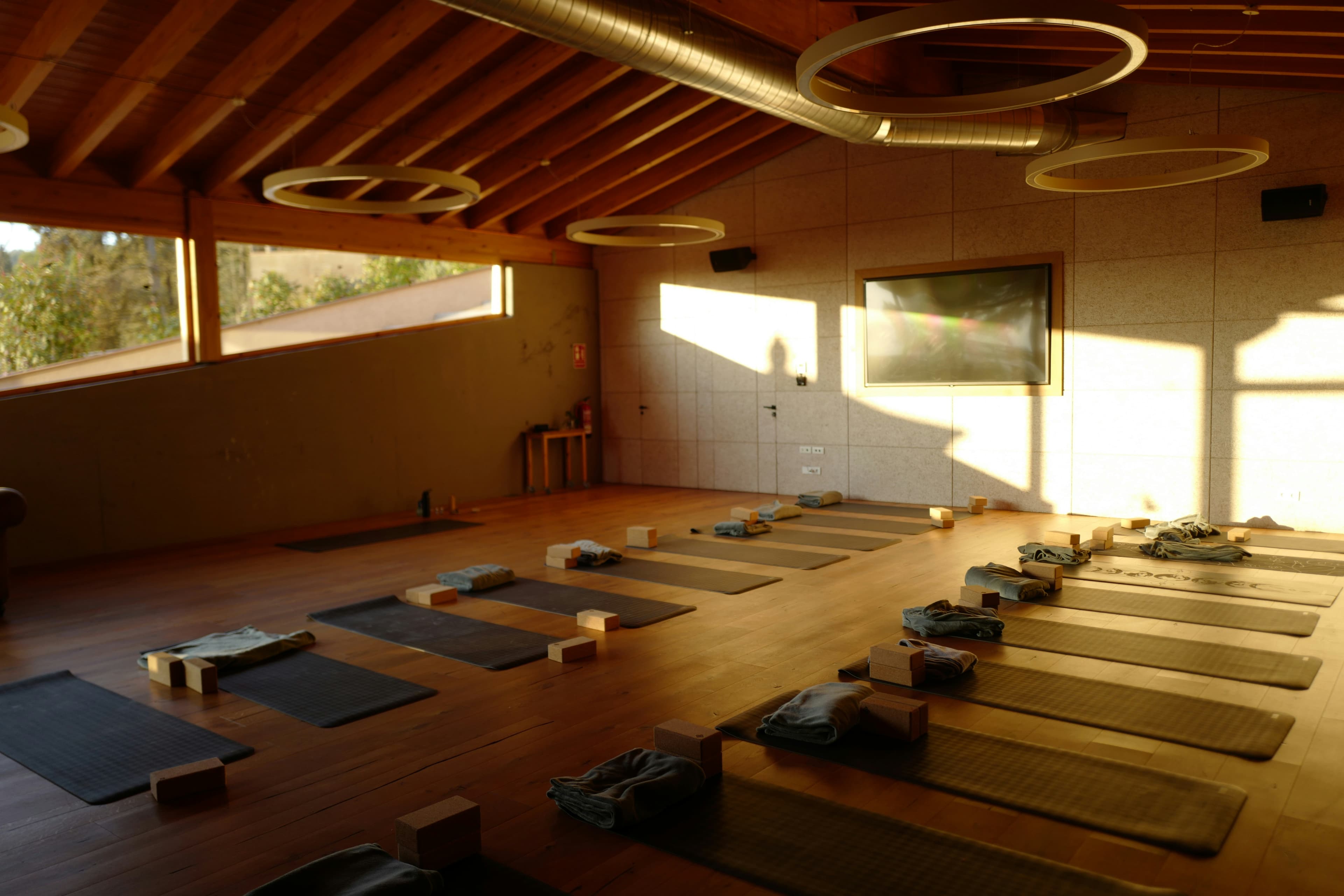
A typical day on a 200-hour course: a two-hour asana and pranayama class at dawn, then lectures on philosophy and anatomy, teaching practice in small groups, a second asana class in the afternoon, and chanting or meditation in the evening. 14 of the retreats we list publish a teacher training course; where they give a length it runs 16 to 42 days, most often about 28. Traditional ashram courses, such as the Sivananda Teachers' Training Course, add karma yoga (seva) and a strict routine.
Certificates, in plain words
- Yoga Alliance (US-based) keeps a registry of schools (RYS) and teachers (RYT). A 200-hour course from a registered school lets you register as an RYT 200. Many studios abroad, and some in Indian cities, ask for it.
- Yoga Certification Board (Ministry of Ayush) certifies yoga professionals in India at levels such as Yoga Protocol Instructor, Yoga Wellness Instructor, Yoga Teacher and Evaluator, and Yoga Master, through its own assessment.
- Traditional schools such as the Bihar School of Yoga and the Sivananda ashrams issue their own certificates, valued for their lineage.
No certificate makes someone a good teacher on its own. Ask schools what their course is recognised by, and ask the studios where you'd like to teach what they look for.
Questions to ask a school before you pay
- Who are the lead trainers, how long have they taught, and will they teach most of the hours themselves?
- How many students are on a course, and how many teachers?
- What does a day look like, hour by hour, and how many contact hours are there in total?
- Which certificate do I get, and which body recognises it? Can I see the school's registration?
- What is included in the fee: room, meals, books, exams? Is the room shared?
- What happens if I'm injured or ill and miss days? What is the refund policy?
- Can I speak to someone who did the course last year?
Be wary of schools that promise a certificate whatever your attendance, list trainers without any background, or push you to pay in full on WhatsApp the same day.
Your body on a training course
Retreats that run a teacher training course
Chosen from our listings by what this guide covers: 6 of 14. Nobody pays to appear here.

 Meditation


 Yoga

 Yoga
- Illustrative photoNaturopathy
Akhilandapuram, Tamil Nadu
Best Nov–Feb
Starts from
From ₹23,000 per programme
- Video still
 Yoga
 Yoga
near Madurai, Tamil Nadu
Best Nov–Feb
Starts from
From ₹500 / night
Common questions
Can a beginner join a yoga teacher training?
Some schools accept beginners, but you'll get more out of it, and strain less, with at least six months to a year of regular practice first. A retreat is the gentler place to start.
Is Rishikesh the best place for a teacher training?
It has the most schools, which means plenty of choice and very mixed quality. Good courses also run in Kerala, Goa, Karnataka, Tamil Nadu and the Himalayas, often in quieter settings.
What does a teacher training cost?
Fees vary widely by school, room and food. Compare what's included rather than the headline fee. Our costs guide shows typical retreat prices from published rates.
Is a 300-hour course the next step?
Yes. Advanced 300-hour courses build on a 200-hour training, and together they make up the 500 hours many registries recognise.
Ask people who've been
Real answers from the community, not the retreats' marketing.
Yoga practice & training forumBrowse next
Sources
- Certification of yoga professionals (opens in a new tab) · Yoga Certification Board, Ministry of Ayush
- Yoga Certification Board (opens in a new tab) · Ministry of Ayush, Government of India
- Yoga Alliance (opens in a new tab) · Yoga Alliance
- Yoga Vacation and courses (opens in a new tab) · Sivananda Yoga Vedanta Dhanwantari Ashram, Neyyar Dam
- Yoga trainings (opens in a new tab) · Bihar School of Yoga
We wrote this guide in our own words from the sources above and our research on each retreat's official site. Nothing here is medical advice: talk to your own doctor about your health. Retreats change their rules, dates and prices, so confirm with them before you book. Spotted something out of date? Tell us.
Read next
All guides- Practicalities
How to choose a retreat in India: goal, style, budget, season and distance
A step-by-step way to choose a retreat in India, from what you need to style, budget, season and distance, with the questions to ask before booking and the red flags that should make you walk away.
5 min read
- Practicalities
What to pack for a retreat in India, by kind and season
A practical packing list for a retreat in India: the basics for any stay, what changes for Vipassana, ashram, Ayurveda, yoga and Himalayan retreats, and what to add for summer, monsoon and winter.
5 min read
- First timers
Staying at an ashram: etiquette and what to expect
How to ask for an ashram stay in India, and what to expect once you're there: dress, the daily routine, seva, food, donations and the unwritten rules that make you a welcome guest.
5 min read
Once a month
New course dates and what's in season, once a month
On the 1st: upcoming course dates, retreats at their best the month after, and the long weekends ahead. Free, and one tap to unsubscribe.